The OPTIMIS project, highlighted in an article in the specialist media outlet Forces Operations, is part of an ambitious drive for technological innovation in land defense systems.
It was developed in part by Nexvision on behalf of John Cockerill Defense as part of a structuring industrial partnership.
OPTIMIS: a collaborative project at the heart of Walloon innovation, a demonstrator for next-generation defense systems
OPTIMIS is above all a collaborative project, bringing together seven industrial and academic partners around a common ambition: to develop disruptive technological building blocks for next-generation defense platforms, in particular multimodal human-machine interfaces for armoured vehicles.
In this context, John Cockerill Defense is leading an open innovation initiative, drawing on complementary expertise to design, integrate and test advanced solutions, particularly in the fields of:
- Optronic perception (camera),
- Decision support & data fusion (on-board vision computer),
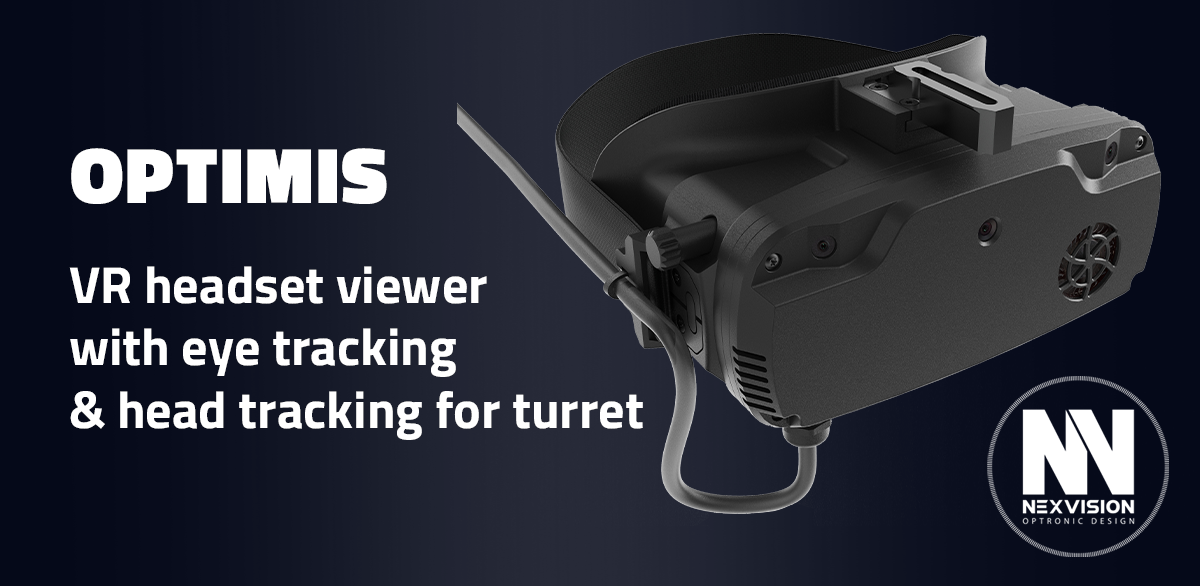
- Human-machine ergonomics (VR headset).
Beyond the prototype, OPTIMIS illustrates a vision: that of smarter, more integrated defense systems capable of effectively exploiting visual information for the benefit of the crew.
Nexvision, a key player in the optronic co-development of OPTIMIS
Within this consortium, Nexvision acted as an optronic design office responsible for the design and development of advanced vision systems.
The Nexvision teams drew on their expertise in several areas:
- Design of a virtual reality headset adapted to defense constraints,
- Design of a 180° bispectral (visible + thermal) panoramic camera,
- Head tracking & Eye tracking,
- Processing and analysis of images and inertial sensors in an embedded environment,
- System integration into an operational demonstrator,
- Consideration of crew usage and human-system ergonomics.
This approach marks a significant evolution in human-machine interfaces in defense environments, with an emphasis on:
- Fluidity of use,
- Reduction of cognitive load,
- Improvement of situational awareness.
OPTIMIS is a concrete example of Nexvision’s expertise in transforming an operational need into an innovative, coherent and usable technological solution.
Nexvision technology at the heart of the system
Beyond the targeting helmet, OPTIMIS relies on several key technologies designed by Nexvision, including:
- Embedded electronic processing modules,
- Panoramic image capture and processing systems,
- Optronic chains adapted to defense constraints.
These components are the building blocks of the system, demonstrating Nexvision’s ability to develop end-to-end solutions, from electronics to software, including optics, mechanics and system integration.
“OPTIMIS was a particularly formative project for Nexvision.
It enabled our teams to take a step forward, both technically and in terms of how we work with a major defense player.
It naturally paves the way for extended reality (XR) projects, particularly those involving augmented combatant concepts (eSAS project).
The ability to merge, contextualise and deliver visual information at the right time via innovative interfaces is a key challenge for the defense systems of tomorrow (autonomous drones), and Nexvision is fully positioned in these areas.
It is part of a broader trend towards intelligent optronic systems integrated into increasingly connected, autonomous and AI-assisted platforms.“, emphasises Vincent Carrier, CEO of Nexvision.
With OPTIMIS, Nexvision confirms its position as an expert design office in vision systems, capable of working on complex, sensitive and structuring projects for the systems of the future.