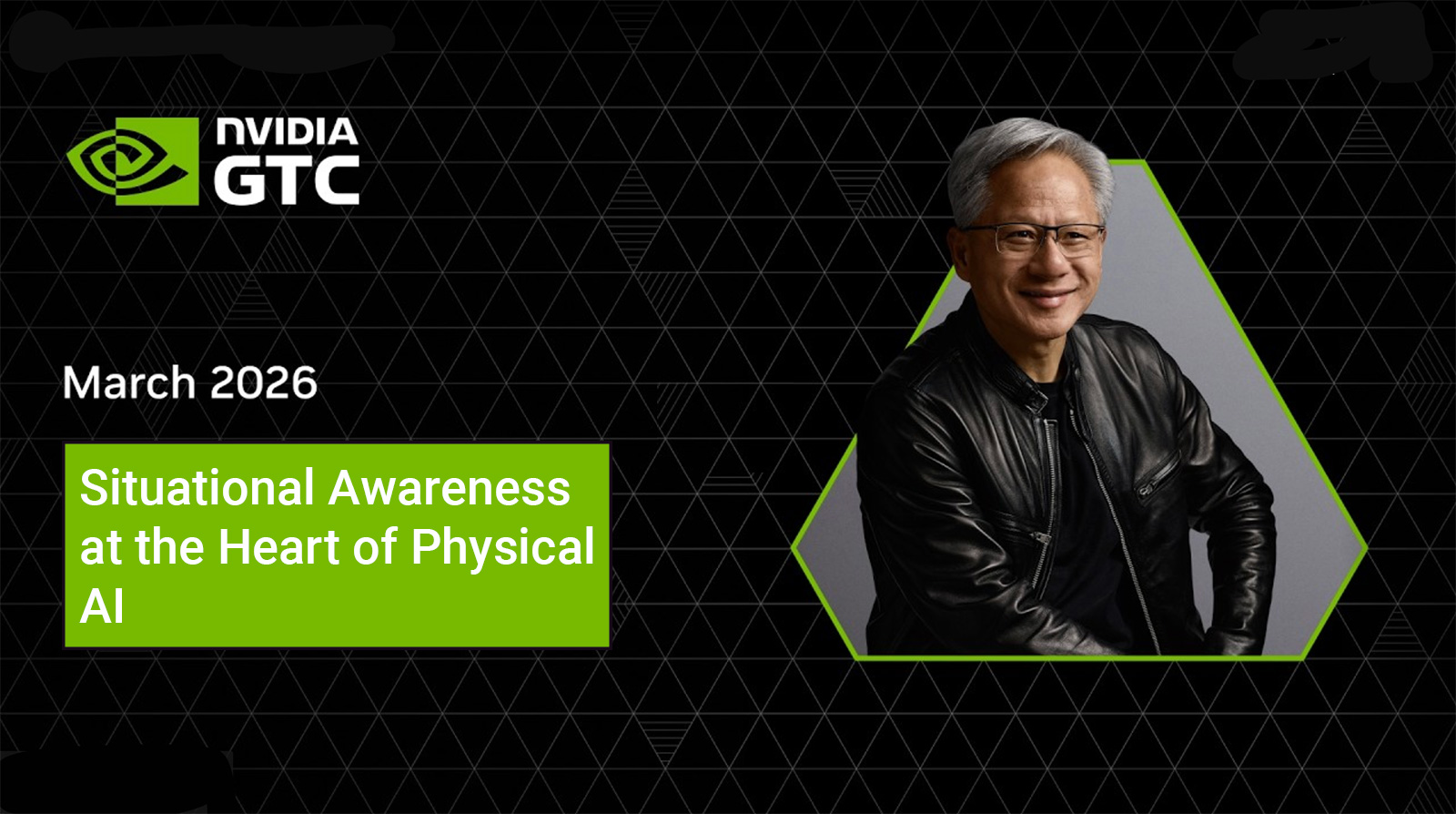
The NVIDIA GTC 2026 announcements mark a significant milestone in the evolution of artificial intelligence. With Vera Rubin for large-scale agentic AI, the expansion of the Nemotron, Cosmos 3, Isaac GR00T N1.7, and Alpamayo 1.5, the NemoClaw environment for OpenClaw with the OpenShell runtime, and the Physical AI Data Factory Blueprint, NVIDIA is laying out a coherent vision: the AI of tomorrow will not be merely conversational or software-based. It will also be embedded, connected to the real world, and capable of perceiving, reasoning, and acting in complex physical environments.
This evolution directly impacts the players designing the technological building blocks at the heart of future autonomous systems. For before autonomy comes perception; before decision-making comes understanding the scene; before action comes the ability to transform sensor data streams into actionable information. It is precisely in this space that Nexvision positions itself, as a specialist in the design of vision systems dedicated to situational awareness (awareness of the situation and the environment in which a person, vehicle, or robot operates) and high-performance embedded processors for data fusion, image processing, and analysis.
NVIDIA’s GTC 2026 announcements confirm the rise of physical AI
Through Nemotron, NVIDIA is advancing agent-based AI toward multimodal systems capable of reasoning and interacting more finely with their environment. With NemoClaw, OpenClaw, and OpenShell, the company is also highlighting a more secure and controlled execution layer for autonomous agents. On the physical AI front, Cosmos 3 is presented as a foundational model of the world, Isaac GR00T as a building block for robotics, Alpamayo 1.5 for autonomous vehicles, and the Physical AI Data Factory Blueprint as an architecture designed to industrialize the generation, augmentation, and evaluation of the data required for these systems.
The underlying message is clear: the intelligent systems of tomorrow will depend on a complete chain linking models, computation, simulation, data, and real-world execution. This perspective is essential for understanding why situational awareness is becoming a strategic function, and no longer merely an observational capability.
Situational awareness, the foundation of future autonomous systems
Before a system can operate autonomously or semi-autonomously, it must first accurately perceive its environment. It must see across multiple spectral bands, recognize a situation, detect a threat, track a target, prioritize information, and provide a clear understanding of the scene. This is precisely what makes situational awareness one of the cornerstones of physical AI. NVIDIA’s announcements regarding Cosmos, GR00T, Alpamayo, and the Physical AI Data Factory Blueprint confirm this market shift: value no longer lies solely in the model, but in the entire chain connecting the real world to decision-making.
From this perspective, onboard vision systems are not peripheral to autonomy; they are one of its prerequisites. Without robust perception, reliable data fusion, and real-time scene understanding, there can be neither credible autonomy nor effective decision support.
Nexvision’s eVSA: A Concrete Solution to the Challenges of Situational Awareness
The eVSA system is a particularly good example of this trajectory. Positioned as a situational awareness solution for vehicles, eVSA aims to enhance situational awareness and automation for intelligence, surveillance, reconnaissance, interception, and combat missions. It combines high-performance computing, HMIs and sensors such as passive imagers (UV, visible, night vision, MWIR, and LWIR thermal cameras), active 3D imagers (LiDaR and proximity RaDaR, SAR RaDaR), acoustic sensors, radio, gas detector, temperature, humidity, haptic sensors, pressure. The system also incorporates functions for environmental perception, threat recognition, driver assistance, threat level assessment and classification, decision support, assisted fire control, and connectivity with other vehicles, autonomous drones, or C4-ISR chains.
As such, eVSA goes far beyond the concept of a simple sensor. It is already part of an embedded intelligent system approach, where value stems from the combination of vision, multi-sensor fusion, an AI processor, and operational output. This architecture is built around high-performance computing + sensors + HMI, as well as an eVPU vision processor designed for data fusion, image processing, and analysis, with a capacity of 1,000 TOPS, 100 Gb/s data throughput, and 100 W.
What the NVIDIA GTC 2026 announcements mean for Nexvision
For Nexvision experts, the announcements at NVIDIA GTC 2026 do not mean that all systems will become autonomous overnight. Above all, they demonstrate that the market is realigning itself around a strong conviction: the intelligent systems of tomorrow will be built on robust, embedded perception building blocks capable of operating in the real world. This is precisely what Nexvision is already preparing for through eVSA and, more broadly, through its expertise in embedded vision systems requiring high computing power, the fusion of multiple imaging technologies, and the design of advanced image processing and analysis algorithms.
In other words, while Nemotron and NemoClaw/OpenClaw embody the rise of intelligent agents, and Cosmos, Isaac GR00T, Alpamayo, and the Physical AI Data Factory Blueprint structure the ecosystem of physical systems capable of learning and acting, Nexvision occupies an indispensable level: the one that connects the physical world to operational intelligence. Without reliable situational awareness, without multi-sensor fusion, and without robust onboard vision, there can be neither credible autonomy nor high-level decision support.
From Situational Awareness to Physical AI
Today, situational awareness must no longer be viewed as a mere observation function, but rather as a strategic layer of physical AI. Complex environments require systems capable of capturing reality across multiple spectral bands, interpreting weak signals, detecting and classifying threats, guiding the operator, and laying the groundwork for future supervised autonomy functions. The systems designed by Nexvision, and in particular eVSA, are fully aligned with this trajectory: that of embedded intelligence capable not only of processing data, but above all of making sense of reality to make better decisions and, in the future, take better action.
In summary, the announcements made by NVIDIA at GTC 2026 do not concern only large-scale AI infrastructures or players in the robotics sector. They confirm a deeper transformation: value will increasingly shift toward systems capable of uniting perception, embedded computing, reasoning, and action in the real world. In this field, Nexvision already has strong credibility.
With eVSA and its expertise in vision systems for situational awareness, the company isn’t just following a trend: it’s helping to prepare, starting today, the architectures that foreshadow the autonomous systems of tomorrow.
Watch Jensen Huang’s full keynote